
What is Maybulk?
Maybulk is Bursa Malaysia’s only listed dry bulk shipping player. Dry bulk shipping largely involves the transport of unpackaged bulk cargo such as grains, coal and iron ore. Maybulk has 16 or 17 bulk carriers in three different sizes namely Handysize, Supramax and Post-Panamax.
Maybulk used to have a 21% stake in PACC Offshore, a Singapore-listed OSV player (same business as Alam Maritim, Icon Offshore and Perdana Petroleum) but sold the loss-making unit to shareholders in 4Q18.
Why is this a trading buy?
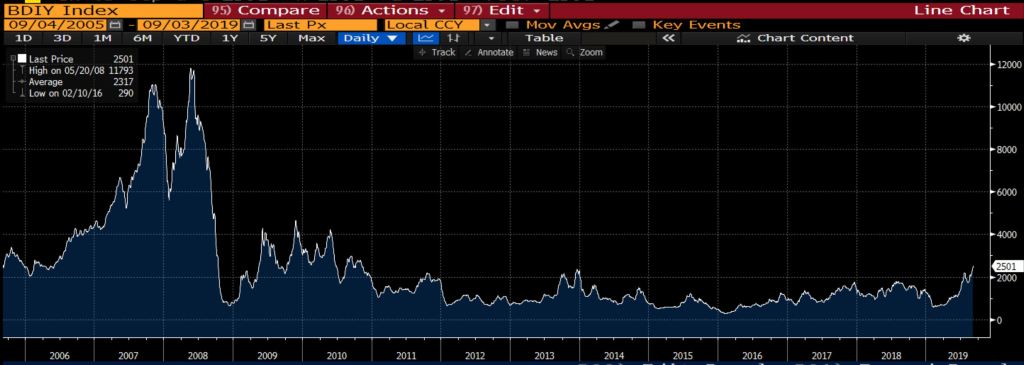
If we exclude PACC Offshore associate contributions and look at the core operating profits after interest level, Maybulk has been operationally loss-making since 2012. This was due to persistantly low shipping rates, a consequence of the boom in bulk carrier orders in in 2007-2008 when shipping rates reached insane levels due to demand for coal and iron ore in China.
The International Maritime Organisation (IMO) has ruled that from 1 January 2020, marine sector emissions in international waters be slashed. The marine sector will have to reduce sulphur emissions by over 80% by switching to lower sulphur fuels.
There are several ways bulk shippers can address IMO 2020: 1) fuel ships with very-low-sulfur-fuel-oil (VLSFO), 2) fuel ships with more marine diesel, 3) fuel ships with LNG, however this option requires engine and infrastructure conversion of the ship or 4) retrofit scrubbers which will still enable to ship to continue burning high-sulfur-fuel-oil (HSFO) – the cheapest of all fuels. All four methods are expensive but options 3 and 4 require the ships to be removed from deployment for installation or conversion.
The world’s operating fleet is expected to be lower than usual in 2H19 as more vessels are taken off for scrubber retrofitting. Anecdotal evidence suggests that scrubber retrofit programmes are taking longer-than-expected which will further reduce the availability of fleet in the market. This has resulted in the upward revision of dry bulk shipping rates indicated by the BDIY index.
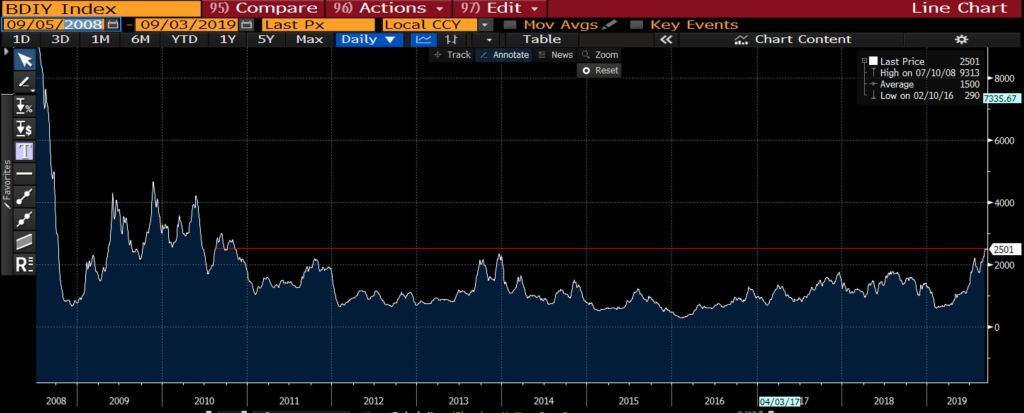
The last time the BDIY index was at current levels was back in 2H2010. A time when Maybulk made approximately RM40+m in core earnings a quarter after removing PACC Offshore’s associate contribution. In FY2010, Maybulk made a net profit of RM238m, with RM38m coming from PACC offshore. The number of vessels also has not really changed much, it had a fleet of 15 vessels in 2010; currently it has 16-17 vessels according to its website and most recent annual report (not sure which one is more up-to-date).
Assuming they can do conservatively RM30m a quarter for the next two quarters at least (keep in mind there might be some lag), Maybulk could be earning approximately RM60m in 2H19 on a market cap of RM660m which looks cheap, in our view. Back in 2010, Maybulk was trading at 11-12x PE. We are advocating a trading buy as we do expect the dry bulk shipping market to normalise after 1Q2020.

